Rick Denham · Presentation summary
Publishing
with a purpose
Seven convictions for Christian publishing. A fuller look at the people, relationships, and ideas behind the books.

A brief Philosophy of Christian Publishing
A book can reach a warehouse, a conference table, or a reader’s home without achieving the purpose for which it was written. For Rick Denham, Christian publishing begins with a deeper question: what should these ideas help people understand, believe, and live out?
In A brief Philosophy of Christian Publishing, Rick brings together lessons from his family’s work in Brazil, the growth of Fiel, and the history of the Reformation. His seven convictions describe a teaching ministry in which books, churches, training, and digital resources support one another. The aim is to equip people and strengthen the local church over generations.
The seven convictions follow a connected line of thought: establish why the work matters, connect readers to a wider community, and develop the people who will carry it forward. These three parts provide a way through the presentation, with practical examples along the way.
Part 01 · Purpose · Convictions 01–02
Why we publish
A teaching purpose gives the catalogue its direction.
Conviction 01Publishing is discipleship, not distribution
Key ideaLet the teaching purpose guide what you publish and how you sustain the work.
Rick begins with the Great Commission, especially the instruction to teach people to observe what Christ commanded. In that setting, a publishing house extends the work of teaching. It serves pastors, churches, and the people learning within them.
This changes the questions that guide a catalogue. A distributor needs to know what will move, what to stock, and what margins will sustain the work. An editor who thinks as a teacher also asks what readers need to understand and in what order. Both kinds of work matter. The teaching purpose should give the commercial work its direction.
Rick locates this conviction in his family’s early ministry in the Amazon. Pastors serving communities around the Solimões and Madeira rivers had very few sound resources in Portuguese. The response began with a bookstore in Manaus, before the later publishing work. The need for teaching came first; the organisation developed to meet it.
For a team, that history becomes a question about its shared purpose. A paycheck describes a transaction, but it cannot by itself explain why a difficult translation is worth finishing or why a small audience deserves careful attention. A clear reason for publishing helps people understand the work they are doing together.
Rick’s practical test is an editorial one: look at the last book the house acquired. Was the decision shaped by a genuine teaching need? Did the editor’s judgment carry weight alongside the expectation of sales?
Conviction 02Ideas have consequences
Key ideaServe readers through faithful translation, careful editing, and the development of local writers.
The content of a book matters because readers carry its ideas into their churches, relationships, and decisions. Rick argues that unclear teaching leaves room for other ideas to shape understanding. Editorial choices therefore carry a responsibility that extends beyond the quality of a finished product.
Translation is a particularly important part of that responsibility. A text can technically reach a new language while remaining difficult to read or failing to communicate the author’s meaning. Faithful translation, clear prose, careful editing, and good production all serve the same purpose: helping the reader understand something worth understanding.
Rick uses Reformation publishing to illustrate that concern. He points to Luther’s frustration with careless printing and translation, and to the importance of communicating in languages people could read. The lesson he draws is that spreading more copies does not excuse spreading ideas badly.
Translation is also a beginning, rather than a permanent substitute for local authorship. As a publishing community matures, its own pastors and writers should be able to address its questions in their own voice. Local knowledge helps a resource speak to the concerns, assumptions, and language of the people receiving it.
The editorial question becomes specific: which need does this book address, and have we communicated its ideas faithfully enough to serve that need?
Part 02 · Connections · Convictions 03–05
How readers keep learning
Connect resources, relationships, and generous service.
Conviction 03Demand is nurtured, not found
Key ideaConnect books, churches, training, and digital resources so people can keep learning together.
At the centre of the presentation is Rick’s ecosystem model: four doorways, one shared set of convictions. People may first encounter an idea through a local church, a book, a training event, or a digital resource. These entry points become more useful when they introduce people to one another.
A reader might discover a teacher on YouTube, pick up a book, attend a conference, and find a community where the ideas can be discussed and lived out. Someone else may begin in a church and receive guidance toward the same books and training. There is no single required order.
The connection is more than a collection of links. Rick describes a shared theological identity that makes the different resources recognisable: the gospel, the person of Christ, and the life and teaching of the church. People gather around those convictions, even when they arrive through different organisations.
His sequence is simple: ideas, people, community, demand. Useful ideas reach people; people find others who share their interest and convictions; community creates a reason to keep learning. Demand for books grows within that activity.
How Rick describes demand
- 01IdeasSomething worth understanding
- 02PeopleReaders who recognise its value
- 03CommunityRelationships that sustain learning
- 04DemandA reason to keep discovering
This is particularly relevant to publishers serving a small language market. If everyone competes only for existing buyers, the possibilities remain narrow. Helping people discover valuable teaching and relationships can develop the reading community itself.
Rick gives a concrete example from a John Piper project in Brazil. The project linked readers to worthwhile Piper books from multiple publishers. The reader’s next useful resource mattered more than keeping every recommendation inside one catalogue. Cooperation still required editorial discernment; the recommendation had to be sound and appropriate.
The practical challenge is to map the connections. Does a book point to further learning? Does a conference help people discover a church? Can someone arriving through a video find a relevant resource? A QR code, a reading recommendation, or a church directory can help. Each resource should offer somewhere worthwhile to go next.
The same pattern in different settings
Rick uses Strasbourg during the Reformation as a historical illustration of preaching, publishing, training, and technology working together. His interest is the relationship among these activities: ideas taught in one setting could travel through another and reach people who entered elsewhere.

Historical illustration · Slide 6
StrasbourgPreaching, publishing, training, and technology offer different ways into the same community of ideas.
Photograph from Rick’s original presentation.He then turns to Fiel in Brazil. Churches and pastors’ networks, Portuguese publishing, conferences, and free digital resources developed as connected parts of the work. He presents this as an example of an ecosystem taking shape over time. It is not a promise that another country will follow the same timetable or achieve the same scale.
The model in practice · Brazil
Four doorways at Fiel.
- Churches
- Pastors’ networks and Brazilian leadership.
- Publishing
- Portuguese resources, local voices, and a study Bible.
- Training
- Conferences and continuing learning.
- Digital
- Free resources through Voltemos ao Evangelho.
Conviction 04Clarity unites, vagueness divides
Key ideaExplain shared convictions and differences clearly while treating partners with charity.
Cooperation requires knowing what an organisation believes and where its boundaries lie. Rick argues that vagueness makes genuine partnership harder: people cannot build a durable community around convictions nobody is willing to explain.
He distinguishes shared commitments from areas where faithful partners may differ. His examples of shared commitments include the gospel, expositional preaching, conversion, evangelism, discipleship, and godly leadership. Questions such as baptism and church government can affect how particular churches are organised while leaving room for cooperation in publishing.
A publisher serves churches, but it is not itself a local church. Rick describes the joy of working with Presbyterian authors through Fiel, a publisher with Baptist convictions. Publishing an author’s work does not require publishing every argument that author makes, and respecting a partner does not require hiding a disagreement.
In the presentation’s historical discussion, Rick uses the dispute at Marburg as a warning about the cost of failed charity. His application is to hold convictions clearly while treating other people generously. The quality of the relationship matters alongside the clarity of the position.
For a publishing house, this may mean sharing authors, recommending another house’s work, or collaborating on training. The test is whether the partnership serves readers faithfully, with everyone able to explain both the common ground and the differences.
Conviction 05Serving sells more than selling
Key ideaGive a book a meaningful place in someone’s learning, whether they purchase it or receive it freely.
Rick’s discussion of generosity starts with the reader’s need. Digital articles, audio, and other freely accessible resources can remove barriers and introduce people to ideas they might never encounter in a bookshop. They provide an accessible beginning to a longer learning relationship.
Physical books raise a different practical question. They cost money to produce and distribute, and a publishing house must think about sustainability. Rick describes using affordable, sometimes subsidised prices so readers can invest in books without making those books inaccessible.
The conversation makes an important qualification: value does not come only from a price. Rick explicitly supports thoughtful book giveaways. A book may become valuable because it connects to a conference someone attended, a question they are working through, or a relationship with a mentor.
A participant in the discussion makes this tangible with a conference example. A book related to a speaker’s subject already has a context and a reason to be read. Follow-up messages can remind participants of the ideas and encourage them to return to the book. Handing out an unrelated stack of spare titles does not create that same connection.
Beyond the handover
Give the book
a place in someone’s life.
A practical reading journey, adapted from the conference and mentoring examples in the discussion.
- 01Connect it to a real questionA conference theme or a need the reader recognises.
- 02Make room to engageTime to read, reflect, and write about the ideas.
- 03Learn with someoneA mentor, a discussion, or a group of fellow readers.
- 04Follow up with purposeReturn to the ideas and their place in the reader’s life.
Rick also describes the Adopt-a-Pastor approach: books are provided within a mentoring and reading programme. Participants engage with the ideas, write about what they have read, and learn with others. The investment may be time, thought, and participation, even when the book itself is free.
That distinction changes what a useful result looks like. A photograph of people holding books records a handover. A reader explaining what the book helped them understand tells a different story. Distribution is valuable, but the work should continue into reading and engagement.
Part 03 · People & continuity · Convictions 06–07
Who carries the work forward
Develop local leaders and take the long view.
Conviction 06People over product
Key ideaDevelop people through relationships, real responsibility, and a path toward local leadership.
Publishing depends on writers, editors, translators, colleagues, and future leaders. Rick asks organisations to care about who these people are becoming, rather than valuing them only for what they can produce.
His examples are often ordinary and personal: opening a home, sharing meals, spending time with younger people, and teaching in a living room. He recalls his parents’ hospitality and the relationships formed around their home. These were part of the ministry from which the publishing work grew.
Leadership development follows the same pattern. People need encouragement and real responsibility before they feel completely ready. They also need room to learn. A founder who keeps every meaningful decision can build a productive operation while leaving it unable to continue without them.
Rick describes an explicit goal, set when he went to Brazil in 2004, to hand leadership to Brazilians. In his account, local leadership is central to the outcome. The work should develop the people who can understand, guide, and carry it forward in their own setting.
Local ownership reaches beyond translating a catalogue. It includes authorship, editorial judgment, authority, and succession. Developing those capacities takes patience because a healthy organisation can only move as fast as the people growing within it.
The presentation’s question is deliberately concrete: who is being welcomed, encouraged, and trusted now? A future leadership team begins with those present relationships.
Conviction 07Faithfulness over fruitfulness
Key ideaMeasure responsibly while allowing time for readers, churches, and leaders to grow across generations.
The final conviction gives the whole presentation its timescale. Rick asks publishers to think in generations. A catalogue can be counted every quarter; the development of readers, churches, and leaders may be visible only after years of consistent work.
His slides trace the work in Brazil from a bookstore in the 1950s, through publishing and conferences, into digital resources and Brazilian leadership. The point is the accumulated life of the work. No single launch explains the whole story.
The long view · milestones described by Rick
A ministry grows over generations.
- A bookstoreResources for churches in Manaus.
- PublishingThe beginnings of Fiel.
- GatheringPastors’ conferences become part of the work.
- Local ownershipAn explicit goal to hand leadership to Brazilians.
- Digital reachVoltemos ao Evangelho.
Rick does not dismiss sound accounting, sales, or the need to sustain an organisation. Earlier in the talk, he insists that these matter. His warning is against allowing easily counted outputs to stand in for the purpose they are meant to serve.
There are seasons when a publisher feels alone, overwhelmed, or unsure whether the work is making a difference. A clear reason for publishing helps sustain that commitment. Within Rick’s Christian understanding of the work, the long view also involves prayer and dependence on God for results that cannot be manufactured by an organisation.
The practical question is retrospective: what did you nearly abandon in its early years that you now understand differently? Patience creates room to see developments that a short reporting cycle would miss.
The books are brooklets. The spring is the Book.
Rick closes with the pamphlet page reproduced in his presentation, identified there as Luther’s address to printers in 1523. He uses its picture of little streams leading to a spring to bring the entire argument back to the purpose of Christian books.
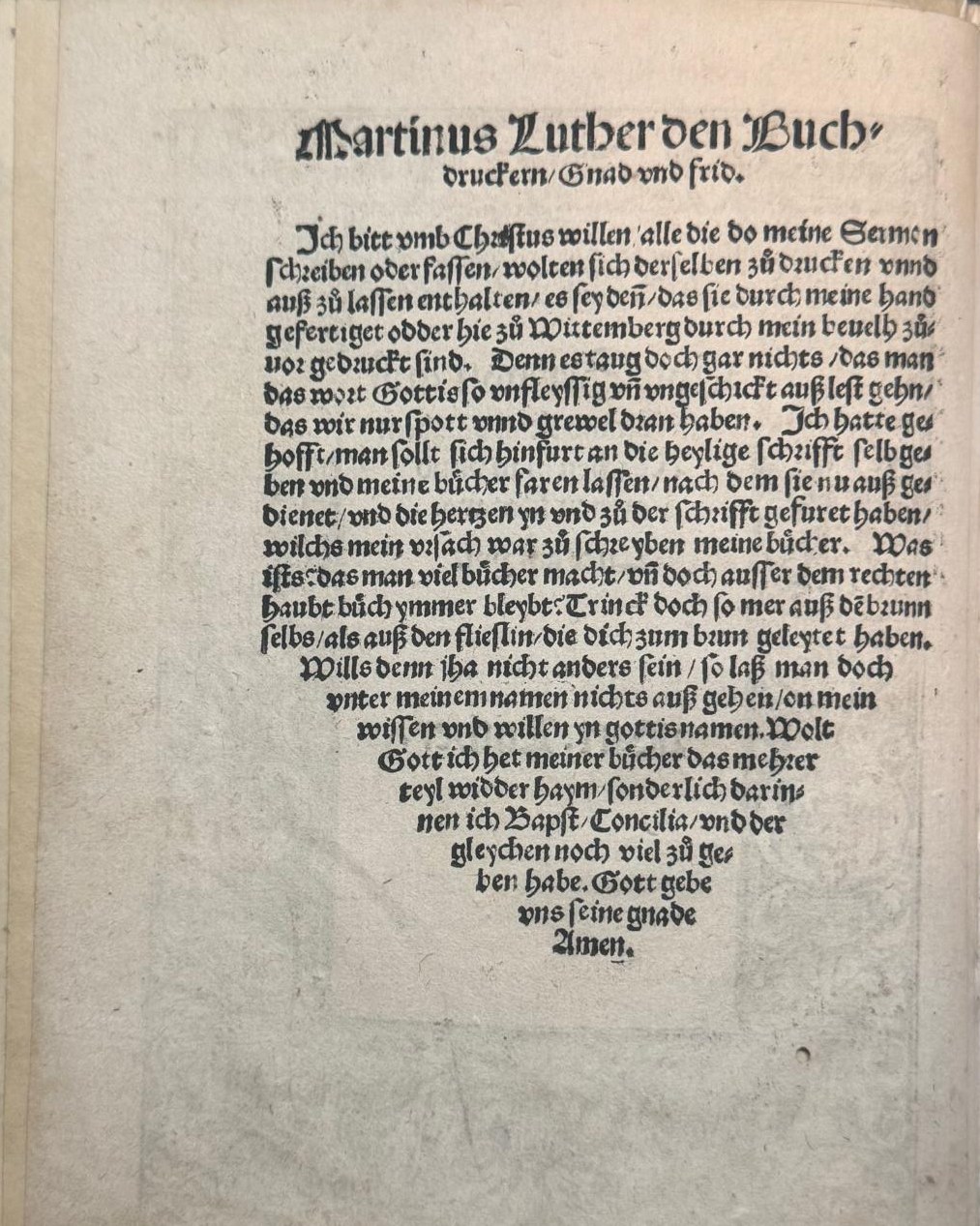
An image from Rick’s presentation
“Drink rather from the spring itself than from the little brooklets that led you to the spring.”
The translation quoted on slide 12, attributed there to Martin Luther’s address to printers, 1523.
See the original slide ↗Good books help readers approach Scripture with greater understanding. Their value includes the direction in which they point. Rick’s accompanying speaker notes carry that thought further: Scripture itself leads readers to Christ. The publisher’s catalogue serves that larger purpose.
This gives craftsmanship a clear reason. Careful translation, beautiful production, useful connections, generous access, and patient investment in people all help resources serve their readers. The quality of the book matters because the reader and the message matter.
Rick ends by asking which of the seven convictions is hardest for the publishing house right now. It is a useful question because it brings an expansive vision back to a particular decision: a book to acquire, a partnership to nurture, a reader to help, or a person to trust with responsibility.
Presentation and ideas: Rick Denham. Summary and visual adaptation prepared for Modulus from “A brief Philosophy of Christian Publishing,” the supplied PowerPoint and its speaker notes, and the accompanying recorded discussion. Illustrations distinguish source material from explanatory adaptations. This is a presentation summary, not a verbatim transcript.